SRILA PRABHUPADA
SPOKEN BY SRILA BHAKTIVEDANTA NARAYANA GOSWAMI MAHARAJA IN BOMBAY INDIA 1994
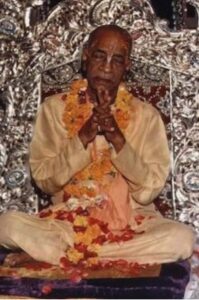
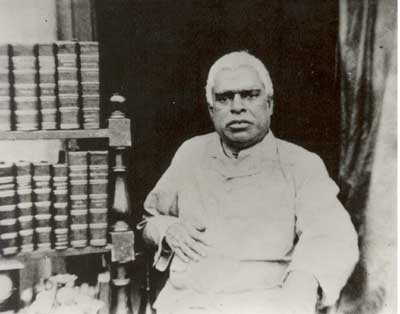
At the time of his divine departure from this world, Parama-pujyapada Srila Bhaktivedanta Swami Maharaja ordered me, "You should serve me by performing my samadhi ceremony." He knew the meaning and significance of entering samadhi, as well as the proper procedures to be performed at that time.
Samadhi is a Sanskrit word consisting of the two syllables, sama-dhi. Sama means "the same" and dhi means "intelligence." When the pure devotee takes samadhi, it means that upon departing from this world he enters the same level, position and spiritual mood as the personal associates of his worshipful Deity. He is serving in that realm according to his own svarupa (constitutional form), with equal qualities, intelligence and beauty as those associates. Srila Swami Maharaja’s worshipful Deity is Srimati Radhika, and he serves Her under the guidance of Her personal associates, the manjaris.

SRILA NARAYANA MAHARAJA
Your Srila Prabhupada has preached about Lord Jagannatha-deva, Sri Krsna-Balarama and various manifestations of Sri Sri Radha-Krsna. But from his writings, books and personal meetings and visits, I am absolutely sure that his worshipful Deity is Srimati Radhika, and he sees Sri Krsna as Her Beloved.
The Complete Conception
At the time of Srila Swami Maharaja’s entering samadhi, his desire was to assist Srimati Radhika in that very place where She renders Her services to Sri Krsna. He was one with the mood of Her maidservants, and he requested my service at that time.
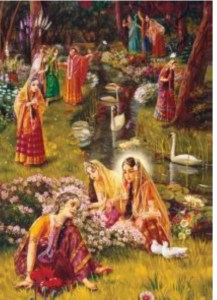
The leader of the manjaris, Sri Rupa-manjari, serves Srimati Radhika when Radhika wants to meet with Krsna. In the dark of night she dresses Radhika in black clothes, and ties Her ankle-bells in such a way that they will not make any sound. At the time of dressing Radhika, she may decorate Her with a necklace, with the Syamantaka jewel as its centerpiece. At that time she may say, "This jewel is the friend of Sri Krsna’s Kaustubha jewel." In this way, Radhika is reminded of Her pastimes with Lord Krsna and bestows all Her mercy upon Sri Rupa-manjari, who always gives so much uddipana (inspiration) to Her bhava.

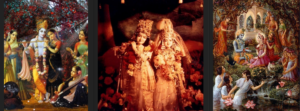
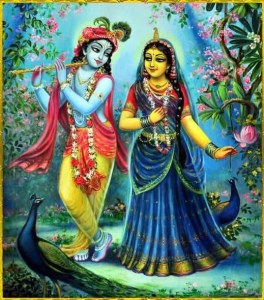
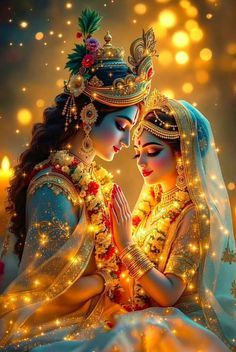
SRI SRI RADHA AND KRISHNA
If one has the mood to assist in his Guru’s service to Sri Rupa-manjari or Srimati Radhika, he renders the best service. I do not know why Srila Swami Maharaja gave me the mercy of giving him uddipana as he entered samadhi. I performed this service by decorating him with tilaka and by writing certain sacred mantras with sandlewood paste on his chest. These decorations indicated his personal services to his worshipful Deity, Srimati Radhika.
Just before his departure from this world, he requested me to sing Sri Rupa-manjari-pada:
sri rupa-manjari-pada, sei mora sampada,
sei mora bhajana-pujana
The lotus feet of Sri Rupa-manjari are my dearmost treasure. They are the topmost object of my worship and inner devotional practices. (Sri Rupa-manjari-pada 1)
sei mora prana-dhana, sei mora abharana,
sei mora jivanera jivana
Her lotus feet are my most cherished wealth, more dear than my own life. They are the exquisite ornament of my life, and indeed, the very essence of my existence. (Sri Rupa-manjari-pada 2)
This is the best sankirtana of Sri Rupa-manjari, who can lead us to Radhika’s service. While I sang this bhajana, I saw that Srila Swami Maharaja’s face was sometimes colored with one transcendental mood and sometimes with another. I requested my brahmacari, Sesasayi prabhu, to sing with me as I personally performed this kirtana for him – just as I did for my Gurudeva at the time of his entering samadhi. There were many similarities between my diksa-guru, Srila Bhakti Prajnana Kesava Gosvami Maharaja, and Srila Bhaktivedanta Swami Maharaja. I did what Srila Swami Maharaja ordered me to do for him, and I feel so fortunate that he gave me this service.
Also just before his departure, he ordered me: "You should advise and help my disciples, all GBC (Governing Body Commision) devotees, and all devotees connected with me."
I did not think I could help them at that time, for I considered them higher in rank than myself. I thought, "They have so much guru-nistha, faith in the lotus feet of their Gurudeva. They are far more advanced than I am. They know the conclusive truths of the Krsna Consciousness philosophy better than I. How can I help them?" But my siksa-guru gave some inspiration in my heart.
By Srila Swami Maharaja’s inspiration I came to know that many disciples were misunderstanding his real identity. They were guessing that his constitutional form is that of a cowherd friend of Krsna. When I heard this, I experienced so much pain in my heart for them – they did not have accurate knowledge or feelings about him. I realized that it is my duty to give them faith in the complete conception of him, that he is in madhurya-rasa. Sakhya-rasa is included within madhurya-rasa, so sakhya-bhava is also within him.
How Deep is the Mountain
There are two ways to see our Gurudeva, and in this connection an analogy can be given of the Himalayan Mountains. The height of the Himalayas is one thing and its depth is another. We can somewhat see its height, but we cannot see what is hidden deep within the ground. We saw that Srila Swami Maharaja collected a large number of disciples throughout the world in practically no time; we saw all varieties of his height. He loved everyone, and everyone felt, "He loves me so much." We also saw this in our Guru Maharaja.
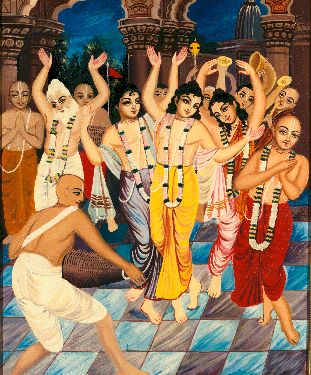
However, we cannot know how deep Sri Guru is. Srila Swami Maharaja used to sing Sri Gurvastakam with a profound mood and tears in his eyes – in samadhi. He did not see who was looking at him and who was not, who was taking part and who was not. He was simply absorbed in singing and playing his karatalas.
The first four verses of Sri Gurvastakam contain very high subject matter that we can realize and see. But at present we cannot realize the next two verses:
sri-radhika-madhavayor apara-
madhurya-lila-guna-rupa-namnam
prati-ksanasvadana-lolupasya
vande guroù sri caranaravindam
At every moment Sri Gurudeva is experiencing intense greed in his heart to taste the unlimited sweetness of the holy names, forms, qualities, and pastimes of Sri Sri Radha-Madhava in Vrndavana. I offer my prayers unto the lotus feet of Sri Gurudeva. (Sri Gurvastakam, verse 5)
nikunja-yuno rati-keli-siddhyai
ya yalibhir yuktir apeksaniya
tatrati-daksyad ati-vallabhasya
vande guroh Sri caranaravindam
Sri Gurudeva is always present with the sakhis, planning the arrangements for the perfection of Yugala-kisora’s amorous pastimes (rati-keli) within the kunjas of Vrndavana. Because he is so expert in making these tasteful arrangements for Their pleasure, he is very dear to Sri Radha and Krsna. I offer my prayers unto the lotus feet of Sri Gurudeva. (Sri Gurvastakam, verse 6)
Only one who is equal to his self-realized Guru can understand his depth. A kanistha-adhikari (novice devotee) and a madhyama-adhikari (intermediate devotee) cannot guess how deep his feelings are. They cannot begin to imagine the fathomless moods of krsna-prema and radha-prema in their Guru’s heart. Without being an uttama-adhikari, a topmost pure devotee, one cannot understand.
Kanistha- and madhyama-adhikari devotees can see his height, his aisvarya (opulence), the way in which he collected disciples and very quickly preached all over the world. But it is more valuable to see his depth. He has not collected disciples just so we can experience his height. Ultimately, he brought us to him with the sole aim of giving us his deep thoughts. Of course this will take time; it could take many births to realize this.
When I look towards him and remember his orders, I become moved, knowing that he is engaged in nikunja-yuno rati-keli-siddhyai. The main reason he came was to give this very same service. He came to obey the orders of Sri Caitanya Mahaprabhu, Nityananda Prabhu and Sri Sri Radha and Krsna, but he had to spend a great deal of time laying the groundwork for this.
His Gurudeva was in a similar situation. Srila Prabhupada Bhaktisiddhanta Sarasvati Thakura has said, "I came to give some valuable conceptions in raganuga-bhava, but I could not do so in the way I desired. Most of my life was spent in sweeping and cutting jungles."
This type of preaching is essential. Without preaching vaidhi-bhakti the main thing cannot be given, because vaidhi-bhakti is a prerequisite for further advancement. Srila Sarasvati Thakura also used to say that when the Mayavada philosophy is present, there can be no preaching of bhakti. We will therefore have to cut the jungles of atheism, Mayavada, sahajiyaism and other non-Vedic philosophies. We will have to spend time defeating their arguments.
Now I think that by obeying Srila Swami Maharaja’s orders, I have been fortunate to play a small role in this deeper mission. If I can inspire raganuga-bhakti in the hearts of devotees, I will see that I have fulfilled the orders he gave me. This is the best service I can render to his lotus feet.
When you are situated in raganuga-bhakti, you will be able to factually see his relationship with Sri Sri Radha and Krsna in gopi-bhava. Then you can deeply think of his services to the Divine Couple in nikunja-yuno rati-keli-siddhyai.
He used to sing daily, "Jaya radha-madhava jaya kunja-bihari gopi-jana-vallabha jaya giri-vara-dhari."
Srila Swami Maharaja has so much transcendental greed to serve Kunja-Bihari. A cowherd boy does not have these sentiments and exalted conceptions. The reference to gopi-jana-vallabha in this song is also in our gopala-mantra, and it filled his heart. He desired to give the service of gopi-jana-vallabha as performed by the gopis.
He saw that there were only a few in this world who were qualified for this; the number could be counted on one’s fingers. Thus, in order to gradually bring his audiences to a level of understanding, he preached about Lord Jagannatha-deva and established Deities of Sri Sita-Rama and Sri Krsna-Balarama.
The gopis also spoke about Rama-Krsna in Srimad-Bhagavatam, but they were not referring to Balarama. Balarama is sometimes called Rama, but the gopis were indicating Ramaniya-Krsna, that is, Sri Krsna the enjoyer of Sri Radha. The gopis’ Rama is Krsna. Qualified devotees, who have actually received the mercy of their Gurudeva, will understand this.
The best service I can render to his lotus feet is to give even an atom of the feelings of these exalted conceptions to his disciples and followers.






















 Everything is temporary