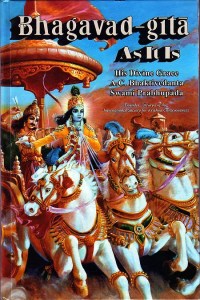
The Bhagavad Gita As It Is by Srila Bhaktivedanta Swami Prabhupada
WHEN EVERY OPINION CLAIMS AUTHORITY, ONLY SELF REALISATION RESTORES VISION.
There is a single question that determines the direction of human life.
Who am I.
Not what is my profession. Not what is my nationality. Not what is my psychological profile. But what am I in essence.
If we do not know whether we are the temporary body, the neural activity of the brain, or an eternal conscious self distinct from matter, then every discussion about God, morality, love, peace, and meaning stands on unstable ground.
In the Bhagavad Gita, Lord Krishna begins not with ritual, nor with cultural identity, but with ontology. He defines the self:
“For the soul there is neither birth nor death at any time. He has not come into being, does not come into being, and will not come into being. He is unborn, eternal, ever existing, and primeval. He is not slain when the body is slain.” Bhagavad Gita 2.20
This is not metaphor. It is a precise description by Krishna Himself 5000 years ago. The self is eternal. It is not produced by matter. It does not perish with the body.
If this is true and we understand it is, then materialism is incomplete. If it is false, then spirituality collapses. Both positions cannot be equally valid.
THE ILLUSION OF RELATIVISM
We are told today that all beliefs are equally true. That different religions merely use different names. That ultimate reality is subjective interpretation.
But truth cannot contradict itself.
If one philosophy says the self is eternal and another says it is a temporary biological event, both cannot be correct in the same sense. If one claims the Supreme is ultimately personal and another insists that ultimate reality is impersonal and without attributes, these are not minor cultural differences. They are mutually exclusive ontological claims. Relativism appears tolerant, but too often it is intellectual avoidance. It replaces clarity with emotional comfort.
Krishna Himself acknowledges how rarely the Soul or Self is truly understood.:
“Some look on the soul as amazing, some describe him as amazing, and some hear of him as amazing, while others, even after hearing about him, cannot understand him at all.” Bhagavad Gita 2.29
Information alone is not enough. Realisation requires purification of consciousness.
VAGUE LEADERSHIP AND THE LOSS OF DIRECTION
In such a climate, many leaders speak eloquently of love, harmony, and unity. These are worthy ideals. But if they cannot clearly explain the distinction between body and soul, matter and consciousness, the individual self and the Supreme, then their guidance lacks foundation.
This is not about personal condemnation. It is about responsibility. A teacher, scientist, philosopher, or religious guide who does not understand the nature of the self may sincerely repeat inherited beliefs. But sincerity does not replace clarity.
Without knowledge of the soul, human beings remain identified with the temporary body. And from bodily identification arise fear, competition, division, and confusion.
THE VEDIC POSITION. CONSCIOUSNESS FIRST
The Vedic literature presents a coherent metaphysical framework. The individual self is eternal, conscious, and individual. It is distinct from the gross and subtle body. It transmigrates from one body to another.
Krishna states:
“As the embodied soul continually passes, in this body, from boyhood to youth to old age, the soul similarly passes into another body at death. The sober person is not bewildered by such a change.” Bhagavad Gita 2.13
Here continuity of identity is affirmed. The body changes. The self remains. The Supreme is not an abstract energy, but the ultimate conscious source, the origin of all living beings. The relationship between the individual soul and the Supreme is eternal. Liberation is not annihilation. It is the restoration of a persons pure, awakened individual consciousness.
PURIFICATION AND LIBERATION
Krishna consciousness is not blind faith. It is a practical process of clearing consciousness from ignorance.
When consciousness is purified through disciplined spiritual practice, hearing, chanting, and dedicated service, the covering of material misidentification gradually dissolves. Self knowledge becomes realised, not theoretical.
Liberation is therefore not escape. It is awakening.
CLARITY OR CONFUSION
There must be a clear distinction between knowledge and speculation. Between realised understanding and vague spirituality. Between clarity about the soul and confusion about identity. Without self realisation, even religion can remain sentimental. Without ontological clarity, even noble language becomes hollow.
Self realisation is not optional. It is the logical foundation of human life. In an age that celebrates relativism, clarity is not intolerance. It is responsibility.
A NECESSARY DISTINCTION
There must be a clear distinction between knowledge and opinion. Between realised understanding and inherited belief. Between clarity about the soul and vagueness about identity.
This distinction is not arrogance. It is intellectual responsibility.
If we do not know who we are, then we cannot truly know God. And if we do not know God, then our highest aspirations remain incomplete.
Self realisation is not an optional spiritual luxury. It is the logical foundation of human life. Without it, we remain in refined ignorance. With it, consciousness awakens, and liberation becomes not a myth, but a lived reality.
Hare Krishna. Thank you for reading. I wish you good health and the rare and precious fortune of coming to realise your true spiritual nature.
Devarsiratha das
Vanaprastha
Disciple of Srila Bhaktivedanta Swami Prabhupada since 1973
Home
https://harekrishnasociety.com/
Subscribe here
All Articles
Please also visit
http://www.purebhakti.com/
 Posted in