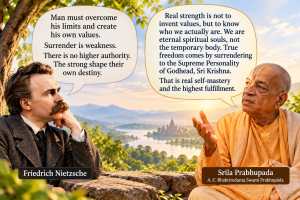
Can man become truly free without understanding who he really is?
Friedrich Nietzsche challenged humanity to overcome its inherited limitations, question conventional morality and develop the strength to create new values. His concept of the Übermensch, commonly translated as Superman or Overman, represents a human ideal that transcends conventional ways of thinking and living.
Nietzsche’s philosophy raises several profound questions. What constitutes genuine strength? Is humility a virtue or a weakness? Can human beings establish their own values without reference to a higher truth? And can a person achieve complete freedom through self-mastery alone?
Gauḍīya Vaiṣṇava philosophy addresses these questions from an entirely different understanding of existence. Its starting point is that the individual is not
the temporary material body but an eternal spiritual soul, whose original identity and fulfilment are inseparable from the Supreme Personality of Godhead, Śrī Kṛṣṇa.
The central disagreement is therefore not whether human beings should overcome their weaknesses. It concerns what the self actually is, what binds it and what constitutes its ultimate perfection.
1. The Superman and the illusion of absolute independence
Nietzsche’s Übermensch, particularly as presented in Thus Spoke Zarathustra, represents the ideal of overcoming conventional humanity and creating values rather than merely accepting those inherited from society. His philosophy places considerable emphasis on independence, creativity, discipline and the transformation of one’s own character. It would therefore be inaccurate to describe his ideal simply as uncontrolled selfishness.
Nevertheless, from the Gauḍīya Vaiṣṇava perspective, an essential question remains unanswered. Can a person become genuinely independent simply by developing greater control over their mind, circumstances and values?
Consider the limitations of ordinary human existence. We cannot prevent the body from growing old indefinitely. We cannot permanently escape disease through determination, nor can we overcome death merely by asserting our will. Even the most powerful individual remains subject to material nature.
The Bhagavad-gītā explains that the fundamental problem is our mistaken identification with the material body. The living being is an eternal spiritual soul, but under the influence of false ego, the soul identifies with the temporary body and mind.
“The living entities in this conditioned world are My eternal fragmental parts. Due to conditioned life, they are struggling very hard with the six senses, which include the mind.”
Reference: Bhagavad-gītā As It Is 15.7, translation, https://vedabase.io/en/library/bg/15/7/
This establishes an essential distinction. The soul is eternally individual, but its independence is minute. The Supreme Lord possesses unlimited independence, whereas the living being possesses only a minute portion of that quality. Consequently, the attempt to establish complete independence through material self-development cannot resolve the soul’s fundamental predicament.
One may conquer a nation, build an empire, acquire extraordinary knowledge or exercise remarkable self-discipline. Yet none of these accomplishments can establish that the individual is independent of material nature. The Gauḍīya Vaiṣṇava understanding of self-overcoming therefore begins with self-realization. Before attempting to become something greater, we must discover who we actually are.
2. The real Superman and mastery over the senses
There is an important point of agreement between Nietzsche’s ideal and the Vaiṣṇava tradition. Both recognize that an individual who remains enslaved by uncontrolled impulses has not achieved genuine mastery. However, the Vaiṣṇava understanding extends beyond psychological discipline.
Śrīla Rūpa Gosvāmī explains in the first verse of Śrī Upadeśāmṛta, translated by Śrīla Prabhupāda as The Nectar of Instruction, that one who can control the urges of speech, mind, anger, tongue, belly and genitals is qualified to guide disciples throughout the world. This is the qualification of a gosvāmī, a master of the senses. Reference: https://vedabase.io/en/library/noi/1/
A person may exercise authority over thousands of others while remaining helpless before their own anger, greed, envy or lust. What kind of mastery is that?
The Vaiṣṇava ideal does not require the suppression of individuality, creativity or determination. Rather, it requires the purification of these qualities through devotional service. A devotee may possess tremendous courage, intelligence, organizational ability and determination. The essential distinction is that these qualities are employed in the service of Śrī Kṛṣṇa rather than for the gratification of false ego.
The true conquest is not simply control over other people or external circumstances. It is freedom from the internal forces that keep the eternal soul bound to material existence.
3. Is surrender a sign of weakness?
Nietzsche’s criticism of what he called slave morality presents another important philosophical challenge. In On the Genealogy of Morality, he argued that certain moral systems arose from resentment among those who lacked the power to express their own strength. He questioned moral ideals that, in his interpretation, elevated weakness and condemned strength. His criticism was principally directed toward particular forms of Christian morality and asceticism. It should not automatically be applied to every spiritual tradition.
Gauḍīya Vaiṣṇavism offers a fundamentally different understanding of surrender. Consider Arjuna on the battlefield of Kurukṣetra. Arjuna was not an incapable or cowardly man. He was an exceptionally accomplished warrior who nevertheless encountered a profound moral and spiritual crisis.
His surrender to Śrī Kṛṣṇa did not require abandoning his courage, intelligence or responsibilities. It required acknowledging that his own understanding was insufficient and accepting guidance from the Supreme Lord.
“Abandon all varieties of religion and just surrender unto Me. I shall deliver you from all sinful reactions. Do not fear.”
Reference: Bhagavad-gītā As It Is 18.66, translation, https://vedabase.io/en/library/bg/18/66/
Here surrender is not submission to an arbitrary human authority. It is the conscious acceptance of the Supreme Personality of Godhead, the eternal source of the living being’s existence. Nor is surrender the destruction of free will.
Śrīla Prabhupāda explains in his purport to Bhagavad-gītā 15.7 that every individual soul possesses personal individuality and a minute degree of independence. This independence can be misused, resulting in material bondage, or properly employed in devotional service. Thus, spiritual surrender represents the proper exercise of freedom.
The devotee does not become spiritually powerful by imagining that they are the Supreme. Rather, they become free from material bondage by restoring their eternal relationship with Him.
4. Does spirituality mean rejecting life?
Nietzsche strongly criticized forms of religion and asceticism that he regarded as hostile to earthly existence. In Thus Spoke Zarathustra, he challenged those who depreciated the physical world in favour of an imagined world beyond it. This criticism raises an important question. Does spiritual realization require rejecting the world, abandoning human relationships and regarding earthly existence as worthless?
Gauḍīya Vaiṣṇavism teaches neither that the material world is ultimately independent nor that it is absolutely unreal. The world is real because it is an energy of the Supreme Lord, but its manifestations are temporary. The problem is not the existence of the world. It is our mistaken belief that we are its independent proprietors and enjoyers.
The principle of yukta-vairāgya, appropriate renunciation, teaches that material things can be engaged in the service of Kṛṣṇa without becoming objects of selfish attachment.
“Whatever you do, whatever you eat, whatever you offer or give away, and whatever austerities you perform – do that, O son of Kuntī, as an offering to Me.”
Reference: Bhagavad-gītā As It Is 9.27, translation, https://vedabase.io/en/library/bg/9/27/
Here is a philosophy of purposeful engagement rather than passive withdrawal. A musician can employ music in glorifying Kṛṣṇa. An artist can express spiritual beauty. A person engaged in ordinary employment can offer the fruits of honest work in devotional service. Even Arjuna’s military responsibilities became an opportunity for spiritual advancement when performed according to Kṛṣṇa’s instructions.
Śrīla Prabhupāda explained in his Bhagavad-gītā lecture in New York on 19 December 1966:
“Now, here is a general prescription for all people for transcendental realization of Kṛṣṇa consciousness. Yat-karoṣi, whatever you do, it doesn’t matter. So you do it for Kṛṣṇa. And how to do it we discussed in the last meeting, that you are doing something; simply change the consciousness that you’re doing for Kṛṣṇa.”
Reference: Bhagavad-gītā lecture, New York, 19 December 1966; verify against original recording/transcript before publishing.
This is not a rejection of activity but a transformation of its purpose. Furthermore, the ultimate spiritual reality described in Gauḍīya Vaiṣṇavism is not an impersonal emptiness or the extinction of individuality. It is the eternal spiritual world, where the liberated soul enjoys a conscious, loving relationship with Śrī Kṛṣṇa.
Spiritual existence is characterized by personal relationships, beauty, loving exchanges and ever-increasing devotional happiness. From this perspective, the ultimate affirmation of life is not endless material self-assertion. It is the awakening of the soul’s eternal spiritual life.
5. The will to power and the purpose of human strength
Nietzsche’s will to power is often misunderstood as merely the desire to dominate others. His conception is considerably broader. It includes self-overcoming, creative expression, the expansion of one’s capacities and the overcoming of resistance. Scholars continue to debate its precise scope and significance.
Nevertheless, his philosophy invites a fundamental question. If the expansion of power is desirable, what determines the proper use of that power? A person may possess exceptional intelligence, discipline, courage and creative ability. These qualities can be employed for the benefit of others or for destructive purposes. Power alone cannot establish the ultimate purpose of existence.
Gauḍīya Vaiṣṇavism approaches this question through the eternal relationship between the individual soul and the Supreme Lord. The living being possesses consciousness, individuality and the capacity to act because the soul is an eternal, minute part of Kṛṣṇa. These capacities are not inherently undesirable. Their proper employment, however, depends upon understanding the soul’s constitutional position.
When intelligence, strength and creativity are employed for selfish gratification, they can deepen material attachment. When engaged in pure devotional service, those same capacities become instruments of spiritual realization. The distinction is not between activity and inactivity, or strength and weakness. It is between activity motivated by false ego and activity arising from spiritual knowledge and devotion.
6. Beyond self-overcoming, the discovery of the eternal self
The fundamental difference between Nietzsche’s philosophy and Gauḍīya Vaiṣṇavism concerns the identity of the individual. Nietzsche challenges human beings to transcend inherited limitations and become creators of values. The Bhagavad-gītā asks a more fundamental question. Who is the individual attempting to overcome those limitations?
If the self is merely identified with the changing body and mind, every material achievement remains subject to time and death. However, the Bhagavad-gītā teaches that consciousness belongs to an eternal spiritual soul, distinct from the temporary physical body.
“Never was there a time when I did not exist, nor you, nor all these kings; nor in the future shall any of us cease to be.”
Reference: Bhagavad-gītā As It Is 2.12, translation, https://vedabase.io/en/library/bg/2/12/
This statement establishes the eternal individuality of both the Supreme Lord and the innumerable living beings. Liberation does not mean that the individual becomes God or that personal identity disappears. The soul remains eternally individual, while Kṛṣṇa remains the Supreme Personality of Godhead.
The ultimate goal of Gauḍīya Vaiṣṇavism is therefore not merely liberation from suffering, mastery over the senses or even the realization of one’s spiritual identity. It is the awakening of pure love for Śrī Kṛṣṇa, known as kṛṣṇa-prema. Such love is not an ordinary emotional attachment, nor is it simply an exalted psychological state. It is the eternal spiritual soul’s pure loving relationship with the Supreme Lord.
The liberated devotee does not become an isolated, self-sufficient being. Rather, spiritual individuality finds its fullest expression through loving exchanges with Kṛṣṇa.
Conclusion. What does it really mean to transcend humanity?
Nietzsche’s philosophy presents a powerful challenge to complacency, conventional morality and passive acceptance of human limitations. Gauḍīya Vaiṣṇavism also calls for profound transformation, self-discipline, courage and freedom from ignorance. However, the two philosophies differ fundamentally concerning the nature and ultimate purpose of that transformation.
Nietzsche’s ideal emphasizes the overcoming of conventional humanity and the creation of values. Gauḍīya Vaiṣṇavism teaches that the eternal soul’s perfection lies in awakening its original relationship with the Supreme Personality of Godhead.
The Vaiṣṇava does not seek to overcome humanity by becoming an independent supreme being. Rather, the devotee seeks to overcome material conditioning by realizing their eternal spiritual identity.
The final question is therefore not simply how powerful, creative or independent a human being can become. It is whether any degree of material self-overcoming can answer the most fundamental questions of existence.
Who am I? Why am I subject to suffering and death? What is the ultimate source of my existence? And what is the eternal purpose of my individuality?
For Gauḍīya Vaiṣṇavism, these questions find their ultimate answer in the eternal relationship between the individual soul and Śrī Kṛṣṇa.
Before attempting to become a Superman, should we not first discover who we actually are?
Hare Krishna.
Devarsiratha das
Vanaprastha
Srila Bhaktivedanta Swami Prabhupada 1973
Home
https://harekrishnasociety.com
Subscribe
X
Sanskrit Glossary
Ps. AI helped with the linguistic assistance in finalizing this text. AI did not create the philosophical content or determine the conclusions. All credit for its substance belongs to my spiritual master Bhaktivedanta Swami Prabhupada and His divine teachings.
 Posted in
  Tags:
Tags: