
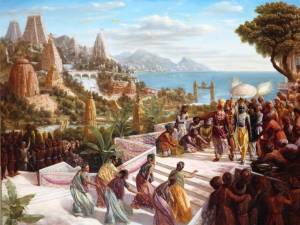
THE ANCIENT VEDIC CIVILIZATION, FORGOTTEN IN COSMIC ANTIQUITY.
Cycles of Time, Lost Civilization’s, and the Continuity of Krishna Consciousness
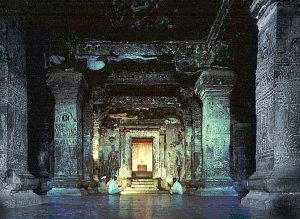
Across the world stand silent witnesses to a forgotten human story. Massive stone structures built with astonishing precision. Stones weighing tens or even hundreds of tons, lifted, shaped, and placed with a mastery that modern technology still struggles to explain. Walls fitted so perfectly that no space exists between stones. Platforms aligned with celestial measurements. Temples carved from the top down into mountains like the Kailasa Temple in Ellora India. These structures are not isolated anomalies.
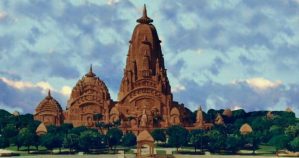
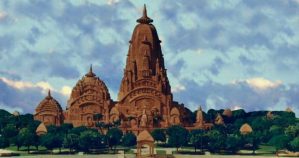
Modern education often treats these remains as curiosities, clever achievements of primitive people, or accidents of lost technique. Yet their scale, accuracy, and global distribution suggest something deeper. They point toward civilisations that were not merely ancient, but highly advanced. Civilization’s whose understanding of matter, energy, and form does not fit comfortably within the modern idea of linear progress see 1*.
This is where the Vedic see 2* perspective offers a radically different lens.
According to Vedic knowledge, time itself does not move in a straight line. It moves in cycles called yugas see 3*. Civilization’s rise, reach extraordinary heights, decline, and eventually disappear. Knowledge is not always accumulated. Often it is lost. What we call progress may actually be recovery after forgetting.
Within this framework, advanced civilisations existed long before the present age. These cultures were not defined primarily by machines, but by consciousness see 4*. Consciousness was understood as the fundamental principle guiding matter, not something produced by matter.
Because of this, Vedic civilisation see 5* developed what may be described as consciousness based technology see 6*.
Power and knowledge were accessed through inner qualification, discipline, and alignment with cosmic law. Technologies described in Vedic texts were not freely available tools. They were regulated sciences.
The Mahabharata see 7* describes weapons such as the Brahmastra see 8*, which could be invoked and withdrawn by knowledge if the target no longer needed to be destroyed. This reveals a moral and conscious restraint unknown to modern warfare. Power was inseparable from responsibility.

Similarly, Vedic texts describe vimanas see 9*, aerial vehicles that were not simply mechanical objects but operated through refined knowledge and trained intelligence. Their functioning depended on the consciousness of the operator, not merely on physical components.
This stands in sharp contrast to modern materialism see 10*, which assumes that matter is primary and consciousness is secondary. In the modern world, technology is external. Anyone with access may use it, regardless of character or inner maturity. Vedic knowledge placed strict inner requirements on the use of power.
When such consciousness centred sciences were lost, little physical evidence remained. Stone, however, endured. The great megalithic structures scattered across the globe may therefore represent the last durable layer of civilisations whose true sophistication was largely internal.
This perspective also resolves apparent contradictions in mainstream history.
Archaeology often presents early humans as primitive while advanced structures appear mysteriously out of place. The Vedic view does not require all humans at all times to exist at the same cultural level. Forest dwellers, pastoral communities, and refined civilisations could coexist within the same age.
We are presently living in Kali Yuga see 11*, the final and most degraded of the four yugas. It is an age marked by loss of memory, shortened attention, moral confusion, and dependence on external technology rather than inner wisdom. In such an age, remnants of past greatness appear mysterious and impossible.
Yet amid all of this change, one continuity remains untouched.
Krishna Consciousness see 12* is described as eternal. It does not depend on any civilisation, technology, or historical period. It exists from the very beginning of creation and continues unchanged through all cycles of time. When civilisations flourish, devotion is openly practised. When civilisations collapse, devotion becomes obscured but never destroyed. Krishna consciousness can be understood as the philosophical and spiritual foundation of Vedic culture, because the Vedic worldview is built upon the recognition of the Supreme Person as the ultimate reality, the soul as His eternal servant, and all social, ethical, and intellectual systems, including ritual, philosophy, and governance, were historically meant to support remembrance of that relationship rather than exist as independent or material goals.
Stones may tell us that something great once existed. The Vedic texts tell us something even more profound. They remind us that while civilisations forget who they were, the relationship between the soul and Krishna never disappears.
Perhaps the greatest mystery is not how ancient people moved stones. Perhaps it is how modern humanity forgot that consciousness itself was once the highest technology of all.
KEY TERMS EXPLAINED
1* Linear Progress Modern thought assumes that human civilisation advances in a straight upward line from primitive origins to ever greater knowledge and refinement, a view commonly called the linear theory of progress. According to this model, early humanity was crude, wisdom increases automatically with time, and modernity is always superior to the past. The Vedic worldview directly rejects this assumption. The Vedas describe time as cyclical, moving through repeating ages in which human society gradually declines rather than improves. In this understanding, ancient humanity was not primitive but spiritually and intellectually elevated, and as time progresses, memory, virtue, lifespan, and true knowledge diminish even as technology increases. From the Vedic perspective, history is not the story of humanity rising upward, but of humanity forgetting what it once knew, making modern civilisation not the peak of progress, but a late stage of decline.
2* Vedic
Referring to knowledge originating from the Vedas, ancient texts describing cosmic order, consciousness, and the nature of reality.
3* Yugas
Cyclical ages of time described in Vedic texts. Satya Yuga lasts 1,728,000 years. Treta Yuga lasts 1,296,000 years. Dvapara Yuga lasts 864,000 years. Kali Yuga lasts 432,000 years.
4* Consciousness
The symptom of the soul, not a product of the brain. In Vedic understanding, consciousness is fundamental and guides matter.
5* Vedic Civilization
A culture guided by Vedic knowledge and dharma, not limited to one region or ethnicity, and described as having once extended widely across the world. According to the ancient Vedic texts such as the Śrīmad Bhāgavatam (Bhāgavata Purāṇa), translated and commented upon by His Divine Grace A.C. Bhaktivedanta Swami Prabhupāda, Vedic civilization flourished hundreds of thousands to millions of years ago, and was spread all over the world, long before the few thousand years covered by modern historical timelines.
6* Consciousness Based Technology
Knowledge systems that functioned through inner qualification, discipline, mantra, and awareness rather than mechanical force.
7* Mahabharata
An ancient Vedic epic describing history, philosophy, warfare, and devotion, set in a highly advanced ancient civilization.
8* Brahmastra
A powerful weapon described in the Mahabharata that could be invoked and withdrawn through precise knowledge and responsibility.
9* Vimanas
Aerial vehicles described in Vedic texts, operated through refined knowledge and consciousness rather than purely mechanical means.
10* Materialism
The belief that matter is the ultimate reality and that consciousness arises from physical processes.
11* Kali Yuga
The present age of decline, characterised by confusion, loss of spiritual memory, and dependence on external technology.
12* Krishna Consciousness
Awareness of the eternal relationship between the soul and Krishna, existing from the beginning of creation and continuing through all yugas.
Devarsiratha das
Vanaprastha
Srila Bhaktivedanta Swami Prabhupada 1973
Home
https://harekrishnasociety.com
Subscribe
https://harekrishnasociety.com/subscribe-for-updates/
Sanskrit Glossary https://harekrishnasociety.com/sanskrit-glossary/
Ps..AI helped with the linguistic assistance in finalising this text. It did not create the philosophical content or determine the conclusions. All credit for its substance belongs to our Acharyas and their divine teachings.
 Posted in

