
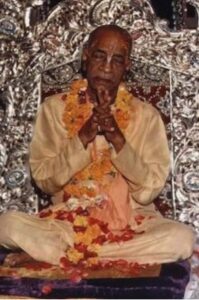
Srila Bhaktivedanta Swami Prabhupada
MOVING FROM RELIGIOUS MYSTERY TO HIGH DEFINITION CLARITY
There comes a moment in life when many thoughtful people quietly realise that certain religious answers no longer satisfy the deeper questions of the heart. For a long time we may accept phrases such as “just have faith” or “God works in mysterious ways.” These expressions may be sincere, but eventually a sincere intelligent seeker begins to wonder whether the ultimate questions of life must remain permanently wrapped in fog. “No one knows” is actually not true.
After all, we live in an age where almost everything else can be examined, analysed, and understood. We can map the human genome, photograph distant galaxies, and measure particles smaller than atoms. Yet when we ask the most fundamental questions of existence.
“Who am I ? Why am I here? Why is there suffering? What happens after death?” Suddenly the conversation often becomes vague and uncertain.
Many people therefore wander through different traditions and philosophies, trying to assemble a coherent picture from pieces that sometimes seem to contradict each other.
But suppose the answers were never meant to remain vague. Suppose there exists a philosophical framework that brings remarkable clarity to these questions, a framework that does not reject other spiritual traditions but places them within a larger and more complete understanding.That is what the philosophy of Krishna consciousness attempts to do, through the guidance of Self realised spiritual masters who have realised these truths and faithfully pass them on through our disciplic succession which is much older than 5000 years and is function perfectly.
Beyond the idea of divine mystery
In many traditions the explanation of life eventually reaches a point where the discussion stops. When difficult questions arise about the mechanics of existence, we are told that such things belong to divine mystery and are beyond human understanding.
Yet the Vedic tradition approaches spiritual knowledge somewhat differently. It presents a systematic explanation of reality. Rather than asking a seeker to suspend intelligence, it invites the seeker to use intelligence carefully.
The relationship between the soul, the universe, and the Supreme is described with remarkable precision. Questions about suffering, destiny, or the nature of consciousness are not dismissed as unknowable. They are examined through concepts such as karma, the nature of the eternal self, and the minute freedom possessed by every living being.
When one begins to see these explanations together, the world starts to make a little more sense. The confusion that once surrounded existence begins to thin out.
The nature of God
Another striking aspect of this philosophy concerns the nature of the Absolute.
Many philosophical systems eventually arrive at the idea of an impersonal force, an abstract energy, or a limitless light. These concepts attempt to describe the divine, yet they often leave the seeker with something strangely distant and impersonal.
The Vedic literature describes the Absolute differently. It explains that the ultimate source of everything possesses form, qualities, personality, and activities. The Absolute is not merely an energy behind existence but the supreme conscious person from whom all energies arise. For many people this realisation feels like the difference between looking at a distant silhouette and finally seeing a detailed portrait.
The spectrum of consciousness
Another question that naturally arises concerns life itself. Does a virus possess life. What about a tree. Is a dog conscious in the same way a human being is conscious.
The Vedic explanation offers a fascinating analogy. It compares consciousness to fire hidden within wood.
Fire exists within every piece of wood, but it does not appear equally in all wood. Some wood barely smoulders. Other wood produces a bright and powerful flame.
In the same way the soul exists in every living form. The difference between species is not the presence or absence of the soul but the degree to which consciousness is expressed.
In non human bodies consciousness is deeply covered. In the human body it becomes highly developed, capable of reflection, inquiry, and spiritual understanding. This view brings a surprising sense of continuity to life. The tree, the animal, and the human are not entirely separate categories of existence. They are different stages in the unfolding expression of consciousness.
Graduating from refined animalism
Human civilisation often prides itself on technological advancement, yet when we examine our daily activities honestly, a familiar pattern appears. We spend enormous effort organising our lives around four basic necessities. Eating. Sleeping. Mating. Defending.
Certainly these activities are natural and necessary. But when they become the central objective of life, human civilisation begins to resemble a highly sophisticated version of animal life.
A dog searches for food and safety. A human with modern technology may do the same just with greater efficiency.
The real turning point in human life begins when a person pauses and asks deeper questions. Who am I beyond this temporary body. Why do old age and death appear unavoidable. Is there a purpose beyond survival. The human form of life is remarkable precisely because it allows these questions to arise.
The great philosophical paradox
For centuries philosophers have debated a fascinating question. Is everything ultimately one. Or are the individual soul and God eternally distinct.Some schools emphasise complete unity. Others emphasise complete difference.The Vedic understanding resolves this debate through the principle of simultaneous oneness and difference.
A simple reflection may help illustrate the idea. Consider a drop of ocean water. In quality the drop is identical to the ocean.
It is water, salty and fluid like the ocean itself.Yet in quantity it is entirely different. The drop cannot carry ships, create tides, or contain vast marine life.
In the same way the individual soul shares the spiritual nature of the Supreme yet remains a distinct individual being.
This understanding preserves two essential truths at the same time. Our deep connection with the divine source and the individuality required for genuine love and relationship.
Coming home to clarity
One of the most refreshing aspects of this philosophical system is that it does not demand that a person abandon every previous belief or spiritual experience. Rather, it often feels like discovering missing pieces of a puzzle. Ideas that once seemed disconnected begin to fit together within a larger framework. It is somewhat like standing beside a car with the hood closed and wondering how the engine works. The Vedic wisdom simply opens the hood and patiently explains the components. What once appeared misterious, begins to reveal a pattern.
A few reflections for daily life
Philosophy becomes meaningful only when it begins to influence how we see ourselves and the world around us.
Sometimes it is useful to pause and observe how our daily energy is spent. Much of our effort goes toward improving comfort, security, and social success. Yet we may ask ourselves an interesting question.
“Is everything I am doing merely helping the body survive, or is some part of my life directed toward understanding the deeper nature of the self.?
Another small reflection may arise during moments of emotional turbulence. When frustration or anxiety appears, we may quietly ask.
“Who is actually experiencing this feeling?. Am I the emotion itself, or am I the conscious observer who is aware of the emotion?”
So when i realise that Iam in fact the observer, the natural question to follow must be “Who am I?”
These simple reflections slowly shift our perspective. Life begins to appear less like a random series of events and more like a meaningful journey of self discovery.
A few common questions
Some people wonder whether studying Krishna Consciousness requires abandoning their present religious tradition.
It does not, because It can be approached more like advanced study. Just as a student progresses from elementary school to higher education, spiritual understanding can deepen over time without rejecting earlier foundations.
Others ask why the human form of life is emphasised so strongly if the soul exists in all embodied beings.The answer lies in the development of consciousness. While the soul is present within the hearts of all entities, the human body provides a unique opportunity for self reflection and spiritual inquiry.
Another question sometimes arises. Is this simply another form of faith?
Interestingly the Vedic tradition describes spiritual knowledge as a form of evidence called revealed sound. It invites a seeker not merely to believe but to examine, reflect, and test these ideas through personal practice and experience. Some scientifically minded people also ask how this philosophy relates to biological evolution.
The two perspectives can be viewed as addressing different aspects of life. Modern science examines the development of the physical body. The Vedic texts describe the gradual unfolding of consciousness through many forms of life until the soul reaches the human stage where genuine self realisation becomes possible.
A final thought
Perhaps the most important shift occurs when a person realises that spiritual knowledge does not belong to blind speculation.
It is more like rediscovering something that was always present but temporarily forgotten.
When that recognition begins to re awaken, the great questions of life no longer feel like distant mysteries. They begin to feel like invitations….Invitations to remember who we truly are.
Sincerely
Devarsiratha das Vanaprastha
Srila Bhaktivedanta Swami Prabhupada 1973
Home
https://harekrishnasociety.com
Subscribe
X https://x.com/devarsirat
Sanskrit Glossary
Ps..AI helped with the linguistic assistance in finalizing this text. AI did not create the philosophical content or determine the conclusions.
All credit for its substance belongs to our Acharya’s and their divine teachings.
 Posted in

